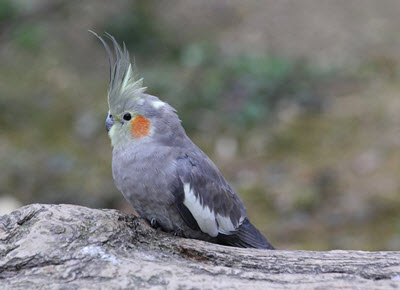
With the arrival of warm weather you may have noticed your
companion male cockatiel has become downright aggressive
towards you, even to the point of biting. Or, alternatively, your
usually sweet cockatiel hen has become rather moody and
developed into quite a grouch. Don’t take it personally, it’s to
be expected, especially if your cockatiel has just celebrated its
first birthday and become sexually mature. For good or ill,
these are nature’s hormones coming into play and the rightful
passage of your cockatiel coming into full sexuality. Driven by
nature, your cockatiel is simply looking for a mate because it
has a need to reproduce.


When bred indoors, cockatiels are non-seasonal breeders –
meaning that their breeding schedule does not have to
coincide with a particular time of year. Reproduction in
cockatiels however, is influenced by weather, specifically by
the amount of heat, humidity and light to which they are
exposed.  


In their native Australia, cockatiels live in the arid interior in
desert conditions and they reproduce during the rainy season
when the increased rain showers provide an abundance of
seeds in the milky stage, which they ingest to feed their young.
The increased humidity and rain also allow the parents to
bathe frequently, providing additional moisture when the
parents return to incubate their eggs. The length of daylight
hours, or photolight period, also provides enough time for
parent cockatiels to seek out an adequate amount of food so
they may properly digest and regurgitate it back to their young.
What does all this have to do with the moodiness of your pet
cockatiel? Your companion is simply responding to the many
factors that would prepare it for raising a family on its own. The
primary factor is its age, which can range from eight to
fourteen months, with twelve months as the average age when
physical sexual maturity is achieved.     


Although some cockatiels may mature faster (e.g., in six to
eight months), it does not necessarily mean they have the
ability or the maturity to successfully raise young.  Raising
offspring at too young an age can endanger the health of
birds that should wait until they are old enough to safely
reproduce. Most reputable aviculturists will not set up a pair
until they are a minimum of twelve to eighteen months of age.
Next, increased daylight or photolight period, such as the
increasing light when spring and summer weather comes into
play can tempt cockatiels to respond as if breeding season
had commenced. Additionally, increased temperature,
adequate humidity, an abundance of proper foods, and finally
– what the cockatiel believes is an appropriate nesting site and
mate – all contribute to throwing a growing adolescent pet
cockatiel into an early adult phase of its life.


Male aggression may be more obvious to observe, because
males clearly sing and strut about, showing off by opening
their wings at the shoulder, bowing, and singing a warbling,
perpetual song that may last for long periods of time. Male
cockatiels will serenade shiny objects at a drop of a hat - from
cage wire, mirrors, and other gleaming items - to singing lustily
for their owners and to other objects to which they bond. Much
to many owner’s surprise, these delightful sessions may end
with an unwelcome hiss or hard, painful nip to the hand as it
seems for no apparent reason, but it is all part of the struggle
of raging hormones and frustration.


Understandably, it appears, the tamer the bird, the far less
fear it has of its owner and so the more likely the occurrence
of an unexpected bite. It would be wise to keep the bird away
from your face at this time, or away from very young children
whose sudden movements might result in a painful bite.
Frustrated males denied the opportunity to reproduce have
been known to attempt to copulate with their perch by rubbing
their tails in rhythmic movements while singing and chortling
enthusiastically. There is no danger to this activity and owners
need not be alarmed by this behavior.


Maturing hens, however, may appear much more grouchy or
focused on looking for a possible nesting site, especially if
they are preparing to lay eggs. They usually begin by
shredding paper at the bottom of their cage, then arrange a
corner so that it is clean of debris in order to deposit eggs laid
one at a time on an every other day schedule.


In fact, both hens and males may shred or tunnel under their
cage paper. If permitted outside the cage, it is not unusual for
a hen to scout out her own nesting site. These nesting sites -
which may appear tempting from the hen’s point of view and
not necessarily your own - may range, for example, from an
unfilled area of a bookcase or an empty shoe, to a bare
bureau drawer or even under the bed.


Prior to laying eggs, hens may be seen lying or “squatting”
straight across the perch, or sitting backed up in a corner of
the cage, with their tails raised high in the air while emitting a
soft, warbling song, that sound like pitiful cries. This gentle
song is utilized by hens to signal to males that they are
receptive and ready to mate.


Bird keepers should carefully watch a hen during the breeding
cycle, especially if she begins to lay eggs, because it is
imperative that hens receive enough calcium in the diet.
The outer shell of each egg is composed of calcium and if the
amount of calcium in the diet is inadequate, the hen will draw
the necessary calcium from her own bones putting herself at
risk for illness and disease. Providing fresh cuttlefish bone
(with the soft side facing towards the bird), dark green, leafy
vegetables ranking high in calcium, along with other
supplements to the diet is essential in order to maintain good
health.


Because most pet cockatiel hens lay eggs at some point
during their lives, many cockatiel owners are concerned with
how to prevent periodic or continuous bouts of egg laying that
may have gone out of control.  


Essentially, there are three categories of egg-production in
cockatiel hens that are frequently encountered. One of the
most common encounters is the unexpected appearance of
eggs that may, or may not, be fertilized by a mate, which can
appear as a complete surprise to the bird keeper. The second
is the planned, intentional breeding of cockatiels to produce
healthy offspring for which the aviculturist is well-prepared and
educated. The third type of egg production results from the
determined action of a single hen to produce eggs regardless
of whether she bonds with another bird, or lives alone.  Of
course, if the hen is without a mate of the opposite sex who
could fertilize the eggs, all the eggs will be infertile.


One of the most worrisome concerns is the occurrence of
chronic egg-laying in adult cockatiel hens, especially when
eggs are produced in large quantities. I often receive mail from
troubled owners with companion female cockatiels that begin
to lay eggs, sometimes clutch after clutch within a short span
of time, others perhaps less often, and some repeating the
cycle after a rest. Because egg-laying is highly stressful, hens
should be watched closely and given nutritional support
throughout the egg-laying process and beyond, when the
eggs are willingly abandoned.  


Always provide an adequate source of calcium through a
dietary supplement containing calcium, phosphorous and
vitamin D3. Calcium is a major component in the formation of
the shell around the egg. Lack of dietary calcium can cause a
dangerous deficiency for egg-laying hens; female cockatiels
that are deficient in calcium will draw the necessary mineral
from their own bones leaving them vulnerable to disease,
osteoporosis, and life-threatening problems such as soft-
shelled eggs and egg peritonitis.  


Offer fresh cuttlebone making it available inside the cage, soft
side facing inward.  Cuttlebone can be easier for eager beaks
to chew whereas the harder mineral block may be more of a
challenge to ingest as quickly. A few ridges scratched across
the surface of the cuttlebone with a clean knife will usually
entice the more hesitant birds to investigate. Scrape
cuttlebone with a clean blade as a powder on top of seed
mixes, favorite table foods, or daily fresh foods such as
greens, egg-food or other soft foods.


Cockatiels that are accustomed to eating a pelleted or
extruded diet (always provided with some seed) are already
have an advantage because pellets will supply most of the
dietary calcium necessary. However, because seeds alone are
deficient in calcium, and because calcium works in conjunction
with vitamin D3 and phosphorus, birds on a solely seed-based
diet may require additional supplementation. Specialty and
supplemental products that contain the correct balance of
calcium, phosphorus, and vitamin D3 can be added to the diet
to maintain adequate blood levels of calcium overall.

Another readily available source of calcium is
"Providing Resources
to the
Cockatiel Community"


The Cockatiel
Foundation, founded in
June 2007, began out
of a growing need in
the avicultural
community to address
all areas of cockatiel
culture. The Foundation
offers its members
programs for pet
owners, breeders and
exhibitors, in addition to
services never before
addressed in the
cockatiel  community.


CF is establishing a
Cockatiel Adoption &
Placement Program
necessary for the
placement and  
rehoming of cockatiels
to new, permanent
"forever" homes.


CF address the needs
of our Youth Members
in the
CF Youth &
Education Program
developed for
tomorrows' next
generation of cockatiel
aviculturists.


Additional special
interest programs
include:
Companion Care
Nutrition
Avian Medicine
Hobby Breeding
Professional Breeding
Color Mutations
Genetics
Exhibition
and more ...


The Cockatiel
Foundation serves all
cockatiel owners needs
 - from breeders,
exhibitors, and pet
companion bird owners
- to cockatiel adoption,
placement and youth
education for
tomorrows cockatiel
afficianados. Please
read our Membership  
benefits  and peruse
the website.

When you join as a CF
Member, you will have
access to the
Members'
Only Area.

COME JOIN US!
Copyright 2007 Cockatiel Foundation, Inc.
Experience CF Online!
Membership information
The Latest News ...
Adoption Program
Companions & Pets
Legbands, Breeding Articles. Registered Aviaries/Sanctuaries
Color Mutations & Genetics
Main Articles including Nutrition, Behavior, more ...
Show information
Lost & Found Cockatiels
Youth Program
All our Links
Contact People and Projects
Home Page
EGG-LAYING BEHAVIORS & PROBLEMS
Part 1of a 4-Part Series

Aggession, Broodiness & Nutritional Needs of
Egg-laying Hens
COPYRIGHT © 2000-2007 LINDA S. RUBIN

Originally published in August 2000 issue of BIRD TIMES Magazine &
CAGE & AVIARY BIRDS, UK, June 28, 2007
"All Rights Reserved"
C. 2007 Shirley J. Bigham
Founded June 3, 2007
Announcing!
CockatielFoundation
DotCom
Click here to go to CockatielFoundation-DotCom!
group
For Foundation Members!
Not a Member?
Join now!